
Property Management Software: A 2026 Guide to Choosing the Right System
June 17, 2026

Choosing property management software in 2026 isn't about feature checklists anymore — it's about picking a system you can actually operate against rising compliance scrutiny, AI-driven workflows, and growing portfolio complexity.
The property management software market sits at roughly USD 7.7 billion in 2026, with forecasts pointing to steady mid-to-high single-digit growth through the next decade[5][6]. But sizing data only tells you the category is healthy. What matters for your business is whether the platform you pick supports clean books, audit-ready records, and the kind of role-based control that protects owner money and tenant data.
Here's what you'll get from this guide:
- A 2026 buying lens focused on bookkeeping accuracy, audit readiness, and operational control — not vendor marketing.
- A decision framework keyed to your business model: multifamily, HOA, short-term rental, hospitality, construction-adjacent, or mixed.
- A side-by-side comparison of the leading property management software platforms, with sourced positioning and noted limitations.
- An implementation checklist covering migration, chart-of-accounts setup, permissions, and month-end close.
- A compliance lens shaped by the RealPage/Greystar settlements and the EU AI Act's August 2026 deadline.
Let's get into what's actually changed for buyers this year.
1. The 2026 Property Management Software Buying Landscape: What Has Changed
Two years ago, buyers compared property management platforms mostly on feature breadth and price. In 2026, the conversation has shifted toward AI capability, mobile usability, and how well a platform handles compliance risk. If your shortlist still looks like a spreadsheet of checkboxes, you're evaluating with last decade's lens.
1.1 AI, Mobile, and Unified Workflows Are Now Baseline
AppFolio's 2026 Benchmark Report ties AI adoption directly to better growth and performance optimization across property management businesses[9]. AI features that used to be "nice to have" — automated reconciliations, intelligent maintenance triage, predictive vacancy modeling — are now expected.
TechRadar's 2026 buyer's ranking treats cloud-first, mobile-accessible platforms with built-in accounting, tenant databases, maintenance ticketing, and screening as table stakes[2]. If a vendor pitches these as differentiators, they're behind the market.
The bigger shift: buyers no longer want a stack of point tools stitched together. They want one unified system where leasing, accounting, maintenance, and communications all live[1]. Every handoff between disconnected tools is a place where reconciliations break and audit trails get murky.
1.2 Compliance and Legal Risk Are Reshaping Software Selection
The Greystar/RealPage settlement reset what "responsible software use" means in this industry. The nation's largest property manager agreed to stop setting rents through RealPage as part of the settlement, signaling that algorithmic pricing logic and audit trails are now legal exposure points[10].
If you're operating across borders, the EU AI Act's potential August 2026 compliance deadline matters too. U.S. operators using high-risk AI features — including any global or cross-border portfolios — fall within scope[11].
The practical implication for your software selection:
- Record retention needs to be configurable and defensible.
- Role-based permissions must be granular enough to separate trust funds from operating accounts.
- AI transparency — pricing logic, screening logic, communication automation — has to be documented.
- Fair Housing safeguards need to be baked into screening and marketing modules.
Compliance-by-design isn't a procurement add-on anymore. It's a core selection criterion.
1.3 Market Growth Signals Sustained Investment
Hospitality tech alone attracted roughly $1 billion in funding, led by property management systems and AI platforms — strong evidence that the category is still consolidating and innovating[8].
Forecasts vary depending on methodology, but the direction is consistent:
- Conservative estimates put the market at USD 5.89 billion by 2033 at 6.4% CAGR[3].
- Broader definitions project USD 17.1 billion by 2035 at 9.3% CAGR[5].
- Alternative analyst views from Fortune Business Insights round out the picture with similar growth trajectories[4].
Different math, same story: vendors will keep investing, which means features will keep changing — and your switching costs will keep mattering.
With the landscape clear, the next question is how to match the right platform to your specific business model.
2. A Decision Framework: Match Property Management Software to Business Model and Control Needs
The biggest mistake operators make is shopping for software the way they shop for a phone — by feature spec. Property management software is operating infrastructure. The right choice depends on what kind of portfolio you run, how complex your accounting is, and what your internal team can actually configure and maintain.
2.1 Start With Portfolio Type, Not Feature Lists
Different portfolio types have different non-negotiables. Here's a starting framework:
- Single-family and small multifamily (under ~50 units): Prioritize ease of use, bank-feed reconciliation, and tenant communication. You don't need enterprise reporting — you need clean books and fast rent collection.
- Mid-market multifamily (50–500 units): Prioritize CAM reconciliations, owner statements, role-based permissions, and reporting depth[1]. Operational complexity grows non-linearly past 50 units.
- HOA/community associations: Prioritize assessment billing, violation tracking, and board reporting workflows. Standard multifamily tools usually don't handle these well.
- Short-term rental and hospitality: Prioritize channel management, dynamic pricing with documented logic, and strict trust-accounting separation. The PMS funding wave shows this segment is moving fast[8].
- Construction-adjacent portfolios: Prioritize job costing, draw schedules, and vendor compliance documentation. Generic property management tools rarely handle construction GL properly.
If you run a mixed portfolio — say, multifamily plus short-term rentals plus an HOA contract — you'll either need a platform that handles all three or two systems with a documented reconciliation process between them.
2.2 Score Platforms Against Operational Outcomes, Not Just Features
AppFolio's multi-category scorecard covers Core Operations, Financial Reporting, Compliance, Scalability, Analytics, Portals, and Mobile[1]. That's a reasonable starting frame, but if you care about back-office performance, add these bookkeeping-specific criteria:
- Reconciliation speed: How fast can bank feeds clear month-end?
- Chart-of-accounts flexibility: Can you customize GL structure without breaking reports?
- Audit trail granularity: Does the platform log who changed what, when, and why?
- Owner-reporting quality: Are statements clean, branded, and exportable?
TechRadar's buyer heuristic still applies: assess demand complexity and internal IT capability before locking in enterprise-tier tooling[2]. A 200-unit operator buying an enterprise platform without the team to run it will get worse results than the same operator on a simpler tool with disciplined processes.
2.3 Decide Build-vs-Outsource for Back-Office Operations
Here's something most vendor roundups skip: software alone doesn't solve manual bookkeeping overload, after-hours coverage gaps, or staffing turnover. It amplifies whoever's running it. A great platform with a stretched two-person back office still produces late owner statements, missed reconciliations, and audit gaps.
That's where a managed back-office team — bookkeeping, virtual assistants, and after-hours coverage — sits alongside the platform to actually deliver ROI. If you're already feeling the strain of manual data entry or struggling to keep up with reconciliations, a managed bookkeeping team configured against your platform can be the difference between software that helps and software that just adds another login.
3. Comparing the Leading Property Management Software Platforms in 2026
Most 2026 property management software rankings are vendor- or affiliate-led. That doesn't make them useless — vendors know the category — but it does mean you should read positioning critically and cross-check with independent sources and customer references.
3.1 What the Major Independent and Vendor Sources Say
TechRadar's 2026 shortlist includes Buildium, AppFolio, Re-Leased, Rent Manager, and MRI, with Buildium positioned as portfolio-agnostic from 3 to 3,000 units[2].
AppFolio's self-comparison cites G2 Spring 2026 Grid signals, framing AppFolio, Entrata, and DoorLoop as above average for ease of use, and Yardi, RealPage, and Buildium as below average in that same framing[1]. That's a vendor-selected lens, so treat it directionally rather than as a verdict.
AppFolio also claims support for portfolios ranging from 100 to 10,000+ units, with dedicated migration specialists and role-based training[1].
3.2 Side-by-Side Snapshot: Best-Fit Use Cases
Here's a consolidated view of the leading platforms based on the cited sources. All positioning is sourced — not endorsed — and you should validate against your own demos and customer references.
| Platform | Best-Fit Portfolio | Accounting Depth | Notable Strengths | Noted Limitations | Source |
|---|---|---|---|---|---|
| AppFolio | 100–10,000+ units, multifamily | Deep (CAM, owner statements, bank integrations) | AI/automation, unified workflows, onboarding support | Vendor-led positioning; premium tier | [1] |
| Buildium | 3–3,000 units, SFR to mid multifamily | Solid core accounting | Portfolio-agnostic, accessible UX | Below average ease-of-use per cited G2 framing | [1][2] |
| Yardi | Enterprise multifamily/commercial | Deep, enterprise-grade | Scalability, breadth | Below average ease of use per cited framing | [1] |
| RealPage | Enterprise multifamily | Deep | Suite breadth | Recent rent-setting legal scrutiny (Greystar settlement) | [1][10] |
| Entrata | Mid-to-large multifamily | Strong | Above average ease of use per cited framing | Less coverage in independent reviews | [1] |
| DoorLoop | SMB landlords | Moderate | Above average ease of use; cost-conscious | Lighter for enterprise/compliance needs | [1][7] |
| Rent Manager | Mid-market, mixed portfolios | Strong, customizable | Flexible workflows | Steeper configuration | [2] |
| Re-Leased | Commercial-leaning | Strong | Lease and commercial-focused | Less residential depth | [2] |
3.3 Reading the Rankings Critically
A few things to keep in mind when reading any 2026 software roundup:
- Most rankings are vendor-led or affiliate-monetized. Cross-check claims against independent sources and customer references[1][2][4].
- Pricing transparency is uneven across the category. AppFolio cites a September 2024 customer survey to support its pricing/transparency claims, but methodology varies by vendor and most won't publish list prices at all[1].
- G2 Grid positioning reflects user-reported usability, not necessarily accounting depth or compliance fit. A platform that's "easy to use" for property managers may still be weak for bookkeepers.
Demo at least two platforms with your real workflows — rent posting, owner statement generation, month-end close — before signing. Selecting the right tool is only half the battle, though. Implementation is where most operators actually lose value.
4. Implementation: Where Most Operators Lose Value
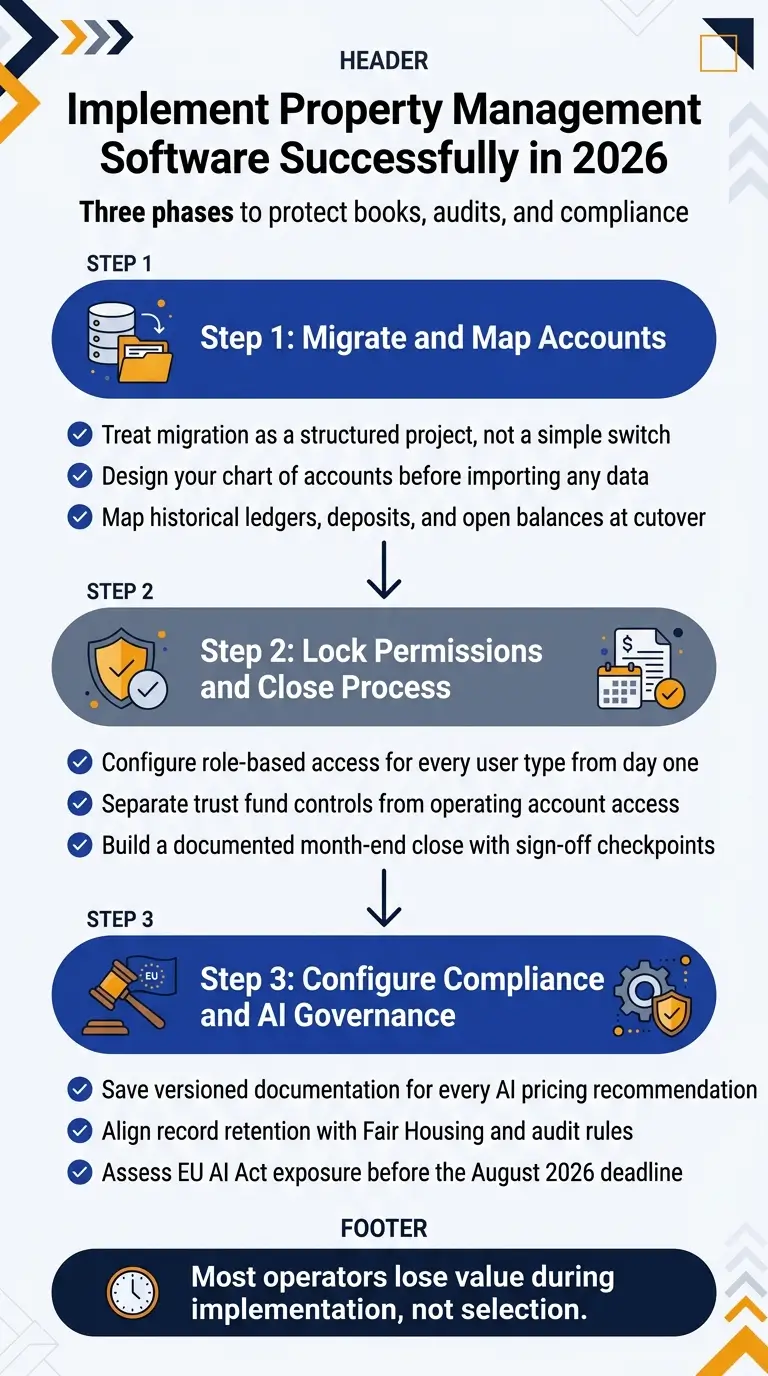
Even the best platform can produce worse books than what you had before if you migrate badly. The pattern is predictable: an operator switches systems mid-year, the chart of accounts gets remapped on the fly, historical reports don't tie, and three months later they're rebuilding owner statements manually.
4.1 Migration and Chart-of-Accounts Setup
Treat data migration as a project, not a switch. At minimum, you'll need to map and validate:
- Historical general ledger
- Tenant ledgers with running balances
- Security deposits (and their separate trust accounts)
- Vendor records and 1099 history
- Recurring entries (rent, fees, automatic charges)
- Open AR and AP balances at cutover
Design the chart of accounts before you import data. Mid-migration restructures are the single most common source of reporting drift, and they're nearly impossible to clean up retroactively without affecting comparative reports.
Vendor migration support helps. AppFolio, for example, offers dedicated migration specialists as part of onboarding[1]. But vendor support doesn't remove your responsibility for data integrity — they don't know your portfolio history, your owner agreements, or which accounts should consolidate.
If you're running a software cleanup or migration and feel like the scope is bigger than your team can handle, a back-office partner with software audit and cleanup experience can compress the timeline and reduce post-migration errors.
4.2 Permissions, Audit Trails, and Month-End Close Discipline
Configure role-based access from day one. Bookkeepers, property managers, owners, and after-hours staff each need distinct scopes. The most common mistakes:
- Giving property managers full GL editing rights
- Letting after-hours agents see financial data they don't need
- Sharing a single admin login across the team
Then build a documented month-end close:
- Bank reconciliations completed and signed off
- Accruals reviewed
- Owner draw approvals locked
- Exception reports run (negative balances, unposted rent, stale receivables)
- Reports issued on a fixed calendar day
Audit-trail requirements are non-negotiable for any platform handling trust funds or owner money. You need to know who changed what, when, and why — and you need to be able to produce that log on demand for an audit or owner dispute.
4.3 Compliance and AI Governance Configuration
The regulatory environment shifted hard in 2025–2026. Configure your platform with that shift in mind:
- Document algorithmic pricing or AI-driven decisions in line with the environment shaped by the RealPage settlements[10]. If your platform recommends rents, save the inputs and the logic version that produced each recommendation.
- Set retention policies for leases, applications, and communications consistent with Fair Housing and state-level record-keeping requirements. Default retention windows are rarely correct out of the box.
- Map AI feature usage against the EU AI Act risk categories if you have any EU exposure, before the August 2026 timeline[11].
Once your platform is configured and your processes are documented, the next question is whether software alone is enough to hit your operational targets.
5. From Software to Operating System: Pairing Tools With a Managed Back Office
Software is necessary but not sufficient. The most common pain points operators report — manual bookkeeping overload, software cleanup and migration issues, compliance and audit readiness concerns, difficulty hiring reliable back-office staff, after-hours coverage gaps — aren't pain points a platform solves. They're pain points people solve, operating on top of a platform.
5.1 Software Solves Workflows; Teams Solve Outcomes
Think of the difference this way:
- A platform posts a rent payment. A bookkeeper reconciles it against the bank deposit, investigates a variance, and adjusts the owner statement.
- A platform logs a maintenance ticket. A virtual assistant dispatches the vendor, confirms completion with the tenant, and updates the owner.
- A platform queues an after-hours call. A trained agent triages it, resolves what they can, and escalates the rest with documented notes.
If your portfolio is growing and your back-office team is shrinking — or stuck in a hiring loop — software alone will keep falling behind your operational load.
5.2 A Practical Onboarding Path
Here's a sequence that works for most operators considering a platform switch or a back-office expansion:
- Software audit and cleanup assessment. Baseline data quality and identify reconciliation gaps before you select or switch platforms. Migrating dirty data into a new system just makes the cleanup harder.
- Platform selection or upgrade. Use the framework from Section 2 — portfolio type, operational criteria, internal capability — to choose a system you can actually run.
- Implementation with documented roles. Migration project, chart of accounts, permissions, audit trail configuration, month-end close calendar.
- Ongoing back-office support sized to load. Layer in bookkeeping, virtual tax, virtual assistants, and after-hours coverage as portfolio complexity grows — matching engagement to operational reality rather than fixed headcount.
Engagement is ongoing and relationship-based for a reason. The platform changes occasionally; the operating rhythm — close, reconcile, report, respond — happens every week. That's the rhythm a managed back-office team is built to sustain.
Conclusion: Choose the System You Can Actually Operate
Picking property management software in 2026 comes down to five things:
- Buying criteria have shifted from feature breadth to AI capability, mobile usability, and compliance-by-design[1][2][9].
- The right platform depends on your business model, portfolio scale, and accounting complexity — not on vendor rankings alone.
- Implementation discipline — migration, chart of accounts, permissions, audit trails, month-end close — determines whether software actually delivers ROI.
- Regulatory shifts around algorithmic rent-setting and AI governance make compliance configuration a first-class selection criterion[10][11].
- Pairing the platform with a trained, managed back-office team closes the gap between software capability and operational outcomes.
If you're evaluating a switch, cleaning up legacy data, or just trying to figure out whether your current platform is the bottleneck, a starting point that works well is a software audit paired with a strategy call. That gives you a baseline on data quality, reconciliation gaps, and platform fit before you commit to any change. Book a free strategy call and software audit to map the right platform — and the right team — to your portfolio.
FAQs
What should I look for in property management software in 2026?
Prioritize AI-supported workflows, mobile accessibility, unified accounting and operations, and compliance-by-design features like granular role-based permissions and audit trails[2][9]. Add bookkeeping-specific criteria like reconciliation speed, chart-of-accounts flexibility, and owner-reporting quality. Avoid scoring platforms only on feature lists — match them to your portfolio type and your team's ability to operate them.
How do I choose property management software based on my portfolio type (multifamily, HOA, short-term rental, or mixed)?
Small portfolios under 50 units should prioritize ease of use and bank reconciliation; mid-market multifamily needs CAM, owner statements, and reporting depth; HOAs need assessment billing and board reporting; short-term rentals need channel management and strict trust accounting[1]. Mixed portfolios usually need either a platform that handles multiple property types natively or a documented reconciliation process between two systems. Start from portfolio type, not vendor rankings.
Is AppFolio or Buildium better for a growing property management business?
AppFolio positions itself for portfolios from 100 to 10,000+ units with deeper accounting and dedicated migration support, while Buildium is positioned as portfolio-agnostic from 3 to 3,000 units with broader SMB accessibility[1][2]. For a fast-growing business expecting to cross 100+ units within a year or two, AppFolio's depth tends to scale better; for smaller operators with simpler needs, Buildium often costs less and onboards faster. Demo both with your real workflows before deciding.
What compliance and audit features should property management software include after the RealPage settlements?
Look for transparent documentation of any algorithmic pricing logic, full audit trails showing who changed what and when, role-based permissions separating trust funds from operating accounts, configurable record retention, and Fair Housing safeguards in screening and marketing[10]. Operators with EU exposure should also map AI feature usage against the EU AI Act's risk categories ahead of the August 2026 deadline[11]. Compliance is now a first-class selection criterion, not a checkbox.
When should I pair property management software with an outsourced bookkeeping or back-office team?
Consider outsourced support when you're seeing manual bookkeeping overload, missed reconciliations, slow owner statements, audit-readiness concerns, after-hours coverage gaps, or back-office staffing turnover — none of which a platform alone can solve. A managed team configured against your platform handles the recurring operating rhythm (close, reconcile, report, respond) that keeps software delivering ROI. The typical onboarding path starts with a software audit to baseline data quality, then layers in bookkeeping, virtual assistant, and after-hours coverage as portfolio complexity grows.
You might also be interested in




100% Match Guarantee
We stand by the quality of our Team Members and guarantee that you will be 100% satisfied with the Team Member assigned to you. If you don't see the value-add, we'll replace and train a new Team Member for free.