
After Hours Support: How Property Managers Can Cut Costs Without Losing Coverage
June 17, 2026

The cheapest after-hours call is the one that never happens. Most property managers try to cut nights-and-weekends spend by trimming staff or routing more calls to voicemail — and end up with bigger problems: missed leasing leads, water damage that spirals into displacement, and tenants who feel ignored.
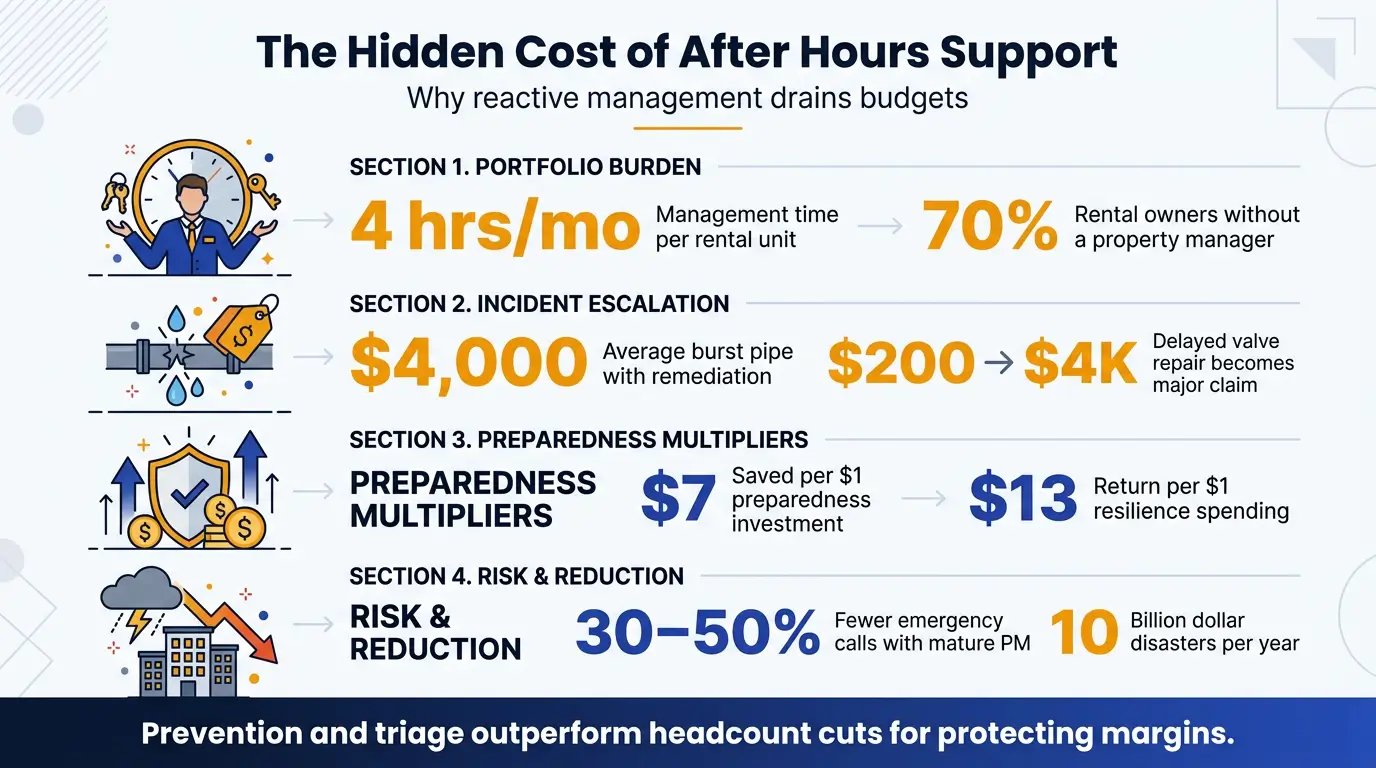
A smarter approach to after hours support is to cut the volume of avoidable calls and triage the rest, instead of cutting coverage. Mature preventive maintenance programs can reduce emergency calls by 30–50%, and a single burst pipe can average around $4,000 once remediation and tenant displacement are factored in.[2] Combine that with clear emergency definitions, a tiered SLA, and outsourced after-hours dispatch, and you can shrink the after-hours budget without giving up tenant safety.
What you'll get in this article:
- A working definition of a true emergency vs. a tenant-perceived urgency
- A three-tier response framework with SLAs you can publish to tenants today
- Coverage models matched to portfolio size — from 1 unit to 250+
- How after-hours incidents tie into bookkeeping, insurance, and audit readiness
- A 30-day rollout plan with measurable KPIs
- Let's start with where the money is actually going.
1. Where After-Hours Spend Actually Goes (and Why It Balloons)
After-hours costs rarely show up as a single line item. They hide across four categories:
- Vendor premiums. Plumbers, electricians, and HVAC techs charge 1.5×–3× their daytime rate for nights, weekends, and holidays.
- Overtime and on-call staffing. If you have in-house techs or property managers carrying the phone, you're paying for sleep-disrupted labor whether they get called or not.
- Missed leasing leads. Calls that go to voicemail at 7 p.m. on a Tuesday don't reschedule themselves — they become lost rent. [5]
- Downstream incident damage. A delayed response turns a $200 shutoff valve into a $4,000 water remediation claim. [2]
Scale makes it worse. Owners spend roughly 4 hours per month per rental on day-to-day management.[4] That number sounds small until you multiply it across 50 or 500 units — and then layer on the unpredictable overhead of nights and weekends.
It also helps to know who's actually doing this work. About 70% of rental owners don't use a property manager,[4] which means most small operators improvise after-hours coverage. They route calls to a personal cell, answer in the middle of dinner, and absorb the hidden costs — slower vendor response, missed leads, and burnout.
The leasing piece is the part most operators underestimate. Renters search and call when they're off work, which is exactly when most management offices are closed. Every unanswered after-hours leasing call is potential rent walking to a competitor.[5] Treat your after-hours model as both a maintenance function and a revenue function.
Now that we know where the money goes, let's look at how to stop it from going there in the first place.
2. Build a Triage Framework That Protects After Hours Support and Cuts Spend
Most after-hours overspend comes from one root cause: everything gets treated like an emergency. A tiered triage framework fixes that.
2.1 Define What Counts as a True Emergency
If you don't define this, your tenants will — and they'll define it generously. A working definition of a true after-hours emergency includes:
- Fire or smoke
- Gas leaks
- Carbon monoxide alarms
- Flooding or major water intrusion
- No heat during a deep freeze
- Complete loss of electricity
- Total plumbing stoppage (all toilets/sinks unusable)
- Structural concerns like sinking floors or standing water[1]
And here's the equally important list — issues tenants think are emergencies but typically aren't:
- Clogged shower drain
- No hot water (in mild weather)
- Lockouts
- AC breakdown
- Noise complaints
- Utility shutoff for unpaid bills[1]
Publish both lists in the lease, the tenant portal, and the welcome packet. Set the expectation before the call happens, not while a frustrated tenant is on hold at 11 p.m.
2.2 Apply a Three-Tier Response SLA
Once you've defined what an emergency is, give each tier a response window and a channel. This is the single most useful artifact you can give an after-hours team:
| Tier | Examples | Response Window | Channel |
|---|---|---|---|
| True Emergency | Fire, gas leak, flooding, no heat in freeze | Immediate | Live agent + on-call vendor |
| Critical | Major appliance failure, single-unit leak | 4–8 hours | After-hours dispatch |
| Non-Urgent | Clogged drain, cosmetic repair, noise | 24–48 hours | Portal/ticket |
The SLA does two things at once: it protects tenants on real emergencies, and it stops Tier 3 issues from triggering Tier 1 vendor pricing.[2]
2.3 Use Misuse Fees and Tenant Education to Reduce Volume
Some managers charge a misuse fee for non-emergency issues routed through the emergency line. It deters overflow and preserves capacity for the calls that actually need an immediate response.[1]
Pair the fee with a scripted intake questionnaire so whoever answers — your team, an answering service, or a virtual assistant — classifies the call the same way every time.[1] Consistency across shifts is what turns a triage policy into actual savings.
Triage handles the calls you already get. The next move is to stop calls from happening in the first place.
3. Lower Volume Before You Lower Headcount: Preventive Maintenance as Cost Control
Cutting after-hours staff is the wrong first lever. Cutting after-hours demand is the right one. Preventive maintenance (PM) is how you do that.
The numbers are hard to argue with:
- PM programs can reduce overall maintenance costs by 12–18%
- They can deliver up to 4× ROI
- Mature programs cut emergency call volume by 30–50%[2]
Zoom out and the preparedness math gets even more compelling. Each $1 of preparedness investment can reduce overall economic costs by about $7, and resilience spending returns roughly $13 per $1 in avoided damage and disruption.[3] Those ratios apply to portfolios as much as they apply to municipalities.
"Every $1 spent on climate resilience and preparedness saves communities $13 in damages, cleanup costs, and economic impact."[3]
— U.S. Chamber of Commerce / Allstate study
The discipline that makes PM actually work is feeding every after-hours incident back into the plan. If you got two water heater calls last quarter, the next quarter's PM list adds water heater inspections. If you had three frozen-pipe events, your fall walkthrough checks insulation and shutoffs. The goal: same failure never happens twice.
Practical PM moves that pay back fast:
- Quarterly water heater and main shutoff inspections
- Seasonal HVAC tune-ups (before peak summer and winter)
- Plumbing camera scans on properties more than 20 years old
- Battery and sensor checks on smoke and CO detectors
- Roof and gutter inspections ahead of storm season
- Dryer vent cleaning (a common, under-tracked fire risk)
After Hours Support Cost Statistics for Property Managers
With PM running and triage in place, the next question is how to staff the coverage that's left.
4. Design an After Hours Support Model That Matches Portfolio Size
There's no single right answer for after-hours staffing. The right model depends on door count, geography, and whether you're managing residential, short-term rental, or hospitality assets.
4.1 Small Landlords (1–25 units)
At this scale, full-time staffing math almost never works. With roughly 4 hours per month per unit of management time,[4] a 10-unit portfolio generates maybe 40 hours of total monthly work — not enough to justify a dedicated after-hours headcount.
The right model:
- Voicemail with a hard-routed emergency line to a live answering service or virtual assistant
- A vetted on-call vendor list with at least two providers per trade
- A simple intake script the answering service follows for classification
This keeps fixed costs low and gives tenants a human voice on real emergencies.
4.2 Growing Managers (25–250 units)
This is where most operators get stuck. Volume is too high for a personal cell phone but too low to justify a 24/7 in-house team.
The right model:
- Outsourced after-hours desk with a documented escalation tree
- Primary and backup vendors with pre-negotiated after-hours rates
- Quarterly vendor performance reviews (response time, first-call resolution, cost per ticket)[2]
- A virtual assistant layer for leasing-call capture so after-hours inquiries become tours, not lost leads[5]
Operators at this stage often need after-hours management support that handles both maintenance triage and leasing intake, so one number serves the whole portfolio.
4.3 Multi-Site and Enterprise Operators (250+ units)
At enterprise scale, the priority shifts from coverage to governance. You need vendor accountability, regional ownership, and clean data flowing back into finance.
The right model:
- SLA-based vendor management with response-time penalties
- Vendor diversification to avoid single-point bottlenecks across regions[2]
- A 24/7 escalation path with named regional owners
- Integration with a back-office team for documentation, invoice coding, and incident reporting
Once you're routing dozens of incidents a month, the bottleneck stops being dispatch and becomes data. Which leads directly to the next point.
5. Connect After-Hours Support to Bookkeeping, Compliance, and Insurance
Every after-hours incident creates a paper trail that affects your books, your audits, and your insurance claims. Emergency invoices, vendor overtime rates, displacement costs, tenant reimbursements — all of it needs consistent coding or it becomes noise in the general ledger.
The simplest way to keep that trail clean is a 72-hour follow-up checklist applied to every incident:
- Hour 1: Acknowledge the call and log it
- Hour 2: Send safety instructions to the tenant
- Hour 4: Confirm vendor ETA
- Hour 24: Provide a repair timeline
- Hour 48: Confirm the repair schedule
- Hour 72: Close the loop and collect tenant feedback[2]
This isn't busywork. Insurance carriers, habitability disputes, and audit reviewers all want time-stamped logs of tenant communication, vendor dispatch, and repair status. Without them, valid claims get denied and audit findings pile up.
The risk picture is real. The U.S. averages 10 natural disasters per year causing $1 billion or more in damage each.[3] Multifamily, STR, and hospitality operators in flood, hurricane, wildfire, or freeze zones need documented response protocols — both to manage the event and to recover the costs afterward.
This is where outsourced back-office support earns its keep. Virtual bookkeeping codes emergency spend correctly the first time, so capex, opex, and recoverable expenses don't get blended. Virtual assistants maintain the incident log and chase missing documentation. After-hours management runs the playbook so your on-call manager isn't writing notes from a phone at 2 a.m.
If your portfolio is growing and your operations team is patching this together with spreadsheets, that's exactly the moment to bring in dedicated virtual bookkeeping and back-office support built for property management workflows.
Now let's put it all on a calendar.
6. A 30-Day Plan to Cut After-Hours Costs Without Cutting Coverage
You don't need a six-month transformation project to see results. Here's a four-week sequence that most teams can execute without adding headcount.
Week 1 — Audit. Pull the last 90 days of after-hours calls. Tag each one by tier (true emergency, critical, non-urgent) and by root cause. You'll see patterns immediately: a small number of properties or failure modes usually drive a disproportionate share of calls.
Week 2 — Educate. Publish the emergency definitions, write a tenant-facing script for the answering line, and roll out a misuse-fee policy in your lease addendum.[1] Send a tenant communication explaining what changed and why.
Week 3 — Operationalize. Stand up the three-tier SLA. Build a vendor scorecard with primary and backup assignments for every trade and region. Pre-negotiate after-hours rates in writing.[2]
Week 4 — Prevent. Launch a PM backlog focused on the top three failure modes from your Week 1 audit. Set up incident-to-bookkeeping coding rules so every emergency invoice maps to the right GL account automatically.
Measure quarterly. Track four KPIs:
- Emergency call volume (target: 30–50% reduction over 12 months)[2]
- Average vendor cost per incident
- Leasing-call capture rate (after-hours inquiries that became tours)[5]
- Percent of incidents fully documented within 72 hours
Those four numbers tell you whether your coverage strategy is working — without needing a quarterly review deck.
Conclusion: Coverage Is Strategy, Not Just Staffing
After-hours cost control isn't about who's holding the phone at midnight. It's about how few calls reach that phone in the first place, how cleanly each one is triaged, and how well each one is documented.
The key takeaways:
- The cheapest after-hours call is the one that never happens — PM and triage do more for cost than headcount cuts.
- Three-tier SLAs and clear emergency definitions protect tenants while shrinking spend.[1][2]
- Your coverage model should scale with the portfolio: answering service for small landlords, outsourced desk plus VAs for growing managers, SLA-driven vendor networks for enterprise.
- Documentation is a financial control. Incident logs and clean invoice coding protect insurance recovery and audit posture.
- Outsourced back-office, bookkeeping, and after-hours management can absorb the operational load without adding fixed payroll.
If you're not sure where your portfolio is leaking after-hours spend — or whether your incident documentation would hold up in an audit or insurance claim — a focused review usually surfaces the biggest fixes in under an hour. Optimal offers a free strategy call and operations audit for property managers and real estate operators who want a second set of eyes on their after-hours workflow, bookkeeping coding, and back-office coverage.
FAQs
What is considered an after-hours maintenance emergency?
A true after-hours emergency is anything that threatens life, safety, or habitability: fire, gas leaks, carbon monoxide alarms, flooding, no heat in a deep freeze, total loss of electricity, complete plumbing stoppage, or structural issues like sinking floors.[1] Issues like clogged shower drains, lockouts, AC breakdowns, or noise complaints are usually not emergencies and can be handled the next business day.
How can property managers cut after-hours costs without hurting tenant service?
Cut the volume of avoidable calls before you cut staff. Implement a three-tier SLA, publish clear emergency definitions, and invest in preventive maintenance — mature PM programs can reduce emergency calls by 30–50% and overall costs by 12–18%.[2] Outsourced after-hours desks and virtual assistants also keep coverage high while replacing fixed payroll with variable cost.
Should small landlords use an answering service or hire on-call staff?
For portfolios under 25 units, an answering service or virtual assistant paired with a vetted on-call vendor list almost always beats hiring on-call staff. With roughly 4 hours of management time per unit per month,[4] the volume doesn't justify a dedicated headcount. A live answering line ensures tenants reach a human for real emergencies without the fixed cost of a salaried employee.
Who pays for emergency maintenance — the owner, manager, or tenant?
Owners typically pay for maintenance that protects habitability and the asset itself. Tenants may be responsible when damage results from their negligence (for example, a child flushing a toy) or when they misuse the emergency line for non-emergencies, which is why some managers charge a misuse fee.[1] Property managers usually pass through vendor costs to owners under the management agreement rather than absorbing them.
How does after-hours documentation affect bookkeeping, insurance, and audits?
Every incident generates invoices, overtime charges, displacement costs, and tenant communications that need consistent coding to stay clean in the books. Time-stamped logs of when a call came in, when a vendor was dispatched, and when the repair closed are often required to support insurance claims and defend against habitability disputes. Following a 72-hour follow-up checklist on every incident[2] protects both audit posture and claim recovery.
You might also be interested in




100% Match Guarantee
We stand by the quality of our Team Members and guarantee that you will be 100% satisfied with the Team Member assigned to you. If you don't see the value-add, we'll replace and train a new Team Member for free.